You sit in the service center waiting area, surrounded by the quiet hum of the parts department and the faint smell of stale roasted coffee. Outside, your Honda CR-V sits patiently in the service lane, ready for its routine oil change and tire rotation. You hand your keys across the counter, fully trusting the professionals to handle the mechanical heavy lifting and keep your engine running smoothly.
The service advisor types rapidly on the keyboard, prints out the final work order, and asks a familiar, cheerful question: ‘We will run it through the wash for you, okay?’ It feels like a small perk to brighten your afternoon. It seems like a complimentary gesture of goodwill from a local business you trust to keep your life moving forward without friction.
You watch through the showroom glass as your crossover disappears behind the heavy, industrial garage doors. What you cannot see is the automated wash bay waiting at the very end of the service line. You cannot see the massive, spinning blue plastic friction brushes that have been aggressively slapping against metal and glass since seven o’clock in the morning.
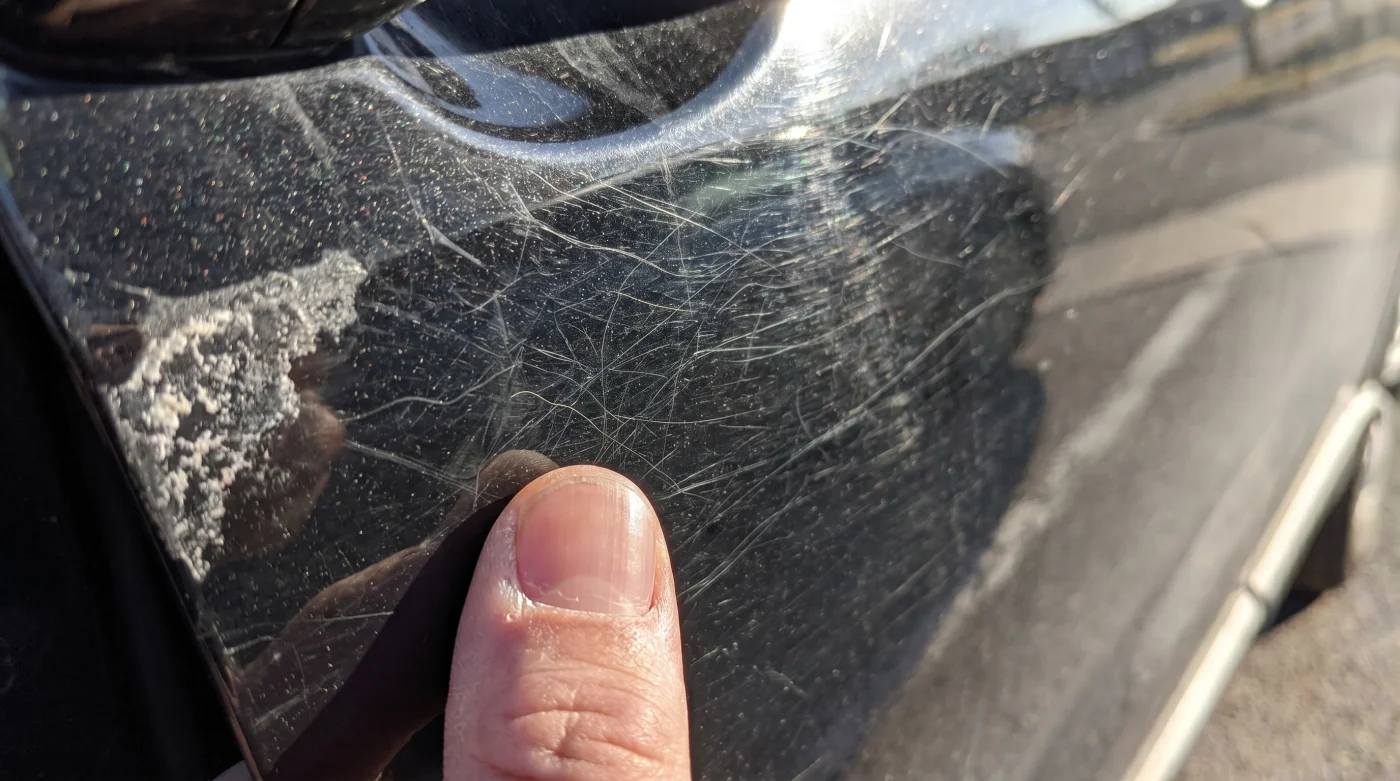
The reality of that enclosed wash bay is far less gentle than the advisor’s polite offer suggests. Those heavy bristles hold the grit, dried mud, and metallic brake dust of the fifty commercial trucks and off-road vehicles that passed through before yours. Dragged forcefully across your paintwork, the spinning brush acts like liquid sandpaper, slowly etching microscopic valleys into a finish that was specifically engineered by the factory to outlast a decade of driving.
The Anatomy of a Thousand Tiny Cuts
Think of your factory clear coat like the surface of a pristine lake at dawn. It relies on absolute smoothness to repel rainwater, resist environmental fallout, and reflect natural light perfectly to show off the depth of the color. When that delicate surface tension is violently whipped by contaminated plastic bristles, it is shattered by millions of tiny scratches known in the trade as swirl marks.
We are heavily conditioned to fear harsh winter conditions, believing that freezing temperatures and road salt are the ultimate threats to our vehicles. Yet, declining the free automated scrub is an act of active financial self-defense. Dealership brushes strip away your clear coat at an aggressive rate, and maintaining the structural integrity of your factory finish translates directly to thousands of dollars retained when it comes time to trade the vehicle in.
Marcus Reyes, a 42-year-old independent detailer in Columbus, Ohio, spends his weeks restoring neglected paint on leased vehicles. He can spot a car subjected to routine dealership washes from fifty feet away just by looking at the reflection on the rear quarter panel in the afternoon sunlight. ‘It looks like someone wiped the doors down with a handful of dry autumn leaves,’ Marcus notes. He frequently sits down with clients to explain that those spinning plastic bristles degrade the factory finish significantly faster than four years of untreated winter road salt. The salt sits on the surface, but the brushes actively carve into the protective layer.
Adapting to Your Driving Reality
Not every owner has the luxury of a private driveway, a shaded garage, and three quiet hours to kill on a Sunday afternoon. You have to adapt to daily constraints to keep your paint safe while managing a busy life.
- The simple maintenance habit quietly destroying your Honda CR-V resale value
- Sudden EV battery surplus forces unprecedented price cuts across major dealerships today
- Urgent recall issued for 30 million airbag inflators affecting highly popular commuter models
- The hidden structural change in the new Tesla Model Y that nobody is talking about
- The specific month you should buy a Kia Telluride to avoid the massive dealer markup
- The fatal engineering flaw pushing Subaru Outback owners to buy Toyota RAV4s
- The $15 OBD2 Scanner trick that instantly reveals if a used car was recently in a flood
- Dealerships are hiding the best Ford F-150 trim for maximum towing capacity
- Mechanics reveal the 5-minute fluid rule that pushes a CVT transmission past 200,000 miles
- Why ignoring the TRD Pro for the base Toyota Tacoma is the smartest financial move of 2024
For the urban commuter, finding the space and a working hose connection is half the battle. If you must rely on public facilities to remove heavy city grime, you need to seek touchless bay washes that use high-pressure water jets and alkaline soaps rather than physical brushes. It removes the surface dirt without ever making physical contact with your delicate clear coat.
For the suburban family, the driveway becomes your personal detailing studio. Kids bring a unique combination of sticky fingers, spilled drinks, and muddy cleats to the exterior of the car. Having a dedicated routine allows you to manage the chaos safely, using high-quality microfiber that traps the dirt rather than dragging it aggressively across the doors.
For the high-mileage commuter, bug splatter and highway road tar become rapidly cemented to the front bumper and side mirrors. Instead of scrubbing harder, you must prioritize a chemical breakdown over physical friction, using a dedicated bug remover spray that gently dissolves acidic proteins before you even pick up a wash mitt.
The Minimalist Preservation Protocol
Protecting your exterior finish does not require a garage wall full of expensive chemical sprays or a heavy professional buffer machine. It simply requires a shift in handling habits regarding who is allowed to touch your vehicle.
The next time you visit the service center, your best defense is a simple piece of paper. Place a sticky note directly over the speedometer with a polite instruction to skip the wash entirely. This single habit prevents severe abrasive damage more effectively than any premium wax or ceramic coating on the open market.
- The Pre-Rinse: Always flush the body panels heavily with water to remove loose grit before you ever touch the paint with a mitt.
- The Two-Bucket Method: Keep one bucket for clean soapy water and a second plain water bucket for rinsing your wash mitt to trap heavy dirt at the bottom.
- The Blotting Technique: Never drag a drying towel forcefully across the surface; lay it flat and gently pat the moisture away like breathing through a pillow.
Your gear should form a strictly minimalist tactical toolkit. A high-pile microfiber wash mitt, a gentle automotive shampoo, and a heavy microfiber drying towel are all you need to maintain a flawless finish week after week.
When mixing your soap in the driveway, keep the water temperate. The ideal washing condition hovers around sixty degrees Fahrenheit, keeping the sheet metal cool to the touch so the soap does not instantly bake onto the windshield glass under the sun.
More Than Just Resale Value
Walking up to a well-kept vehicle at the end of a long, chaotic day offers a quiet sense of order. The way the streetlights reflect flawlessly off the hood provides a subtle reminder that you are in total control of your personal environment.
When you eventually decide to hand the keys over to the next owner, the gloss of the paint tells the entire story of how the machine was treated over its lifespan. A pristine exterior commands a premium price because it proves you cared deeply about the mechanical details nobody else was watching.
The true value of a vehicle is preserved in the moments you choose not to let a machine do a human’s job. – Marcus Reyes
| Key Point | Detail | Added Value for the Reader |
|---|---|---|
| The ‘Do Not Wash’ Note | Placing a physical sticky note on the dashboard during service. | Prevents automated brush damage and preserves clear coat integrity. |
| Two-Bucket Method | Using separate buckets for soapy water and clean rinse water. | Traps abrasive dirt at the bottom, keeping the wash mitt pristine. |
| Touchless Alternatives | Opting for high-pressure water jets and alkaline soaps. | Allows urban drivers to remove heavy grime without physical friction. |
Frequently Asked Questions
1. Are all dealership washes bad for my car? Most use friction-based automated systems that trap dirt from previous vehicles, causing micro-scratches.
2. How do I fix swirl marks on my CR-V? Light polishing by a professional can level the clear coat, but prevention is always cheaper than correction.
3. Is touchless washing completely safe? It relies on stronger chemicals to break down dirt, so you must reapply a wax or sealant twice a year to maintain protection.
4. What type of wash mitt should I use? A high-pile microfiber mitt is best because it pulls dirt away from the surface rather than dragging it along the paint.
5. Does this really affect my trade-in value? Yes. Dealership appraisers physically run their hands over the hood; a glassy finish immediately signals a mechanically sympathetic owner, often adding hundreds or thousands to the offer.